
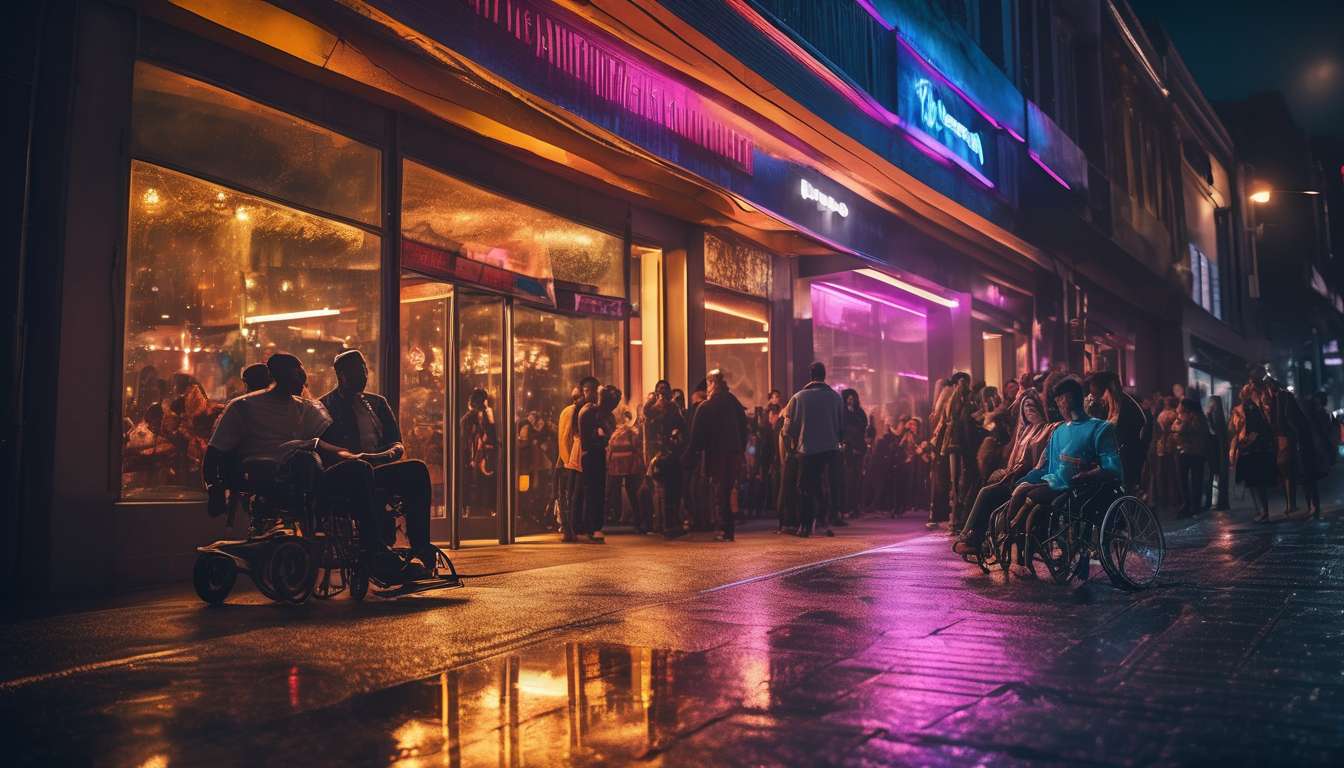
Just 1 in 4 nightlife venues in many cities currently meet basic accessibility standards — a gap we can no longer accept.
We feel the pulse of nightlife as a shared cultural lifeline — a place for connection, expression, and respite — and we are committed to widening its doors.
This article traces practical improvements that transform venues into welcoming spaces for people with disabilities:
- Ramps and accessible restrooms
- Inclusive communication (clear signage, accessible websites, and ticketing)
- Staff training on disability awareness and assistance
We will highlight successful case studies, policy shifts, and affordable design solutions that venue owners and communities can adopt.
By centering lived experiences and collaboration, we show how accessibility enhancements enrich everyone’s nights out, boosting patronage and fostering diverse social scenes.
Together, we can challenge outdated norms and rethink design priorities to create vibrant nightlife ecosystems where mobility, sensory, and cognitive differences are anticipated rather than accommodated as an afterthought.
Why accessibility matters
Accessibility matters because making nightlife venues usable for more people lets us all enjoy social, cultural, and economic life without unnecessary barriers.
Accessible nightlife is about belonging, not just compliance.
When we choose sensory-friendly venues or advocate for thoughtful accessibility upgrades, we open doors for friends, neighbors, and colleagues who’ve been excluded.
We want spaces where people with mobility, sensory, or cognitive differences can arrive, navigate, and participate comfortably.
- Clear signage
- Flexible lighting and sound options
- Step-free routes
- Staff trained to welcome diverse needs
We’re not asking venues to change their character; we’re asking them to expand who can share it.
Investing in accessibility broadens clientele, deepens community ties, and signals that everyone’s presence matters.
We gain richer nights out when more people can join — conversations, performances, and celebrations become fuller and truer.
By prioritizing practical, targeted upgrades, we make nightlife more inclusive and vibrant for all of us.
Assessing venue barriers
We start with an accessibility walkthrough to identify barriers.
- We list physical, sensory, and procedural obstacles that prevent full participation.
- We note steps, narrow doorways, seating arrangements, and layout flow that isolate groups.
- We check lighting, loud music, and unpredictable visual or olfactory stimuli that can make a night out overwhelming for some guests.
- We review signage, ticketing processes, and staff communication for assumptions that exclude people who use mobility aids, assistive devices, or who need clearer information.
We involve community members to ensure solutions are grounded in lived experience.
- Conduct guided walkthroughs and surveys with people who have diverse access needs.
- Use their feedback to identify what’s missing and what’s already working.
We catalog findings against shared priorities.
- Map barriers to agreed values: safety, dignity, and ease of navigation.
- Use that catalog to guide short- and long-term planning.
We prioritize immediate, high-impact fixes while planning longer-term upgrades.
- Implement quick wins: staff training, designated quiet zones, clearer online access information, and improved signage.
- Map and budget for longer-term venue upgrades: ramps, accessible seating, acoustic treatments, and lighting adjustments.
We center real voices so accessibility becomes belonging rather than mere compliance.
- Make decisions with community input at every stage.
- Aim for inclusive nightlife and sensory-friendly venues that welcome everyone.
Physical design upgrades
We’ll focus on physical design upgrades that remove barriers and create safer, more navigable spaces for everyone.
We’re committed to transforming layouts so people can move confidently.
- Widening aisles.
- Lowering service counters.
- Adding ramps and level thresholds.
- Keeping clear sightlines to stages and bars.
Thoughtful lighting and high-contrast signage help guests orient themselves without feeling singled out.
Accessible nightlife means entrances, restrooms, and seating options that work for wheelchairs, scooters, and people who need rests or quieter corners.
We’ll prioritize durable wayfinding, tactile cues, and anti-slip flooring to reduce risk and boost independence.
Flexible seating clusters let groups stay together while accommodating mobility aids.
Venue accessibility upgrades also include accessible stages and viewing platforms so performers and patrons with disabilities can participate fully.
We’ll consult community members to ensure changes reflect real needs, and we’ll maintain the dignity and freedom of everyone who comes through our doors.
These tangible improvements foster belonging and make nightlife truly welcoming.
Sensory-friendly adjustments
We’ll create sensory-friendly adjustments — like quiet zones, predictable lighting, and adjustable sound levels — to help guests with sensory sensitivities enjoy our events.
Designated calm rooms.
- Soft seating and low sensory input.
- Clear maps and signage so people know where to go.
Predictable lighting schemes.
- Gradual dimming transitions.
- Options for non-strobe evenings.
- Clear signage about sensory conditions before entry.
Flexible audio systems.
- DJs and staff can lower bass.
- Quieter zones without sacrificing atmosphere.
Venue accessibility upgrades.
- Staff training to recognize and support sensory needs.
- Sensory kits with earplugs and sunglasses.
- Scheduled quiet hours or sensory-friendly nights.
Why this matters.By making these practical, intentional changes we show people they belong here. Sensory-friendly venues don’t just accommodate differences — they enrich our community and make nightlife genuinely inclusive for friends, families, and all patrons.
Accessible communications
We’ll make our communications clear and usable for everyone by providing captioning, simple language, multiple formats, and advance notices about sensory conditions.
We’ll post event details, quiet hours, and lighting and sound levels in plain language on our site and social channels so people know what to expect and feel welcome.
We’ll offer accessibility resources at events and online:
- Captions and transcripts for videos.
- Tactile maps and large-print menus at the door.
- Downloadable PDFs that follow accessibility standards.
When we announce venue accessibility upgrades, we’ll highlight specific improvements—ramped entrances, seating options, and quiet zones—so attendees can plan confidently.
We’ll share sensory guides for shows and list contact options for arranging accommodations before arrival.
By keeping information current and easy to find, we remove barriers and strengthen community connection.
We want accessible nightlife to be predictable and inclusive, not an afterthought.
Clear, multi-format communication helps everyone participate, making our spaces feel safer and more inviting for patrons seeking sensory-friendly venues and dependable accessibility details.
Staff training programs
We’ll train all staff in disability awareness, communication best practices, and accommodation procedures so they can confidently welcome and assist every guest.
Training methods will include:
- Hands-on workshops.
- Role-playing scenarios.
- Regular refresher sessions.
We’ll teach practical skills for front-line interactions, including:
- How to greet patrons and adjust service for mobility or cognitive needs.
- How to use assistive technologies such as hearing loops and captioning devices.
- De-escalation and sensory-aware techniques to support guests at sensory-friendly events.
Sensory-friendly venue management will cover:
- Managing lights, sound levels, and seating options compassionately.
- Creating procedures for quieter areas and low-sensory routes.
We’ll provide tools and roles to ensure consistent readiness:
- Checklists for accessible nightlife readiness, covering routes, signage, and restroom access.
- Assigning trained ambassadors each shift to troubleshoot requests quickly.
Feedback and continuous improvement will be built in:
- Gathering feedback from disabled patrons and staff with lived experience to refine training content.
- Measuring outcomes to track effectiveness and identify gaps.
Coordination with physical upgrades:
- Aligning training with venue accessibility upgrades so staff practice with the actual equipment and layouts.
- Ensuring changes are practical and visible to patrons.
By investing in people as well as physical improvements, we’ll create nightlife where everyone feels seen, safe, and welcome.
Policy and funding tools
We’ll pursue practical policy measures and targeted funding tools to make accessibility upgrades affordable, enforceable, and sustainable across the nightlife sector.
We’ll advocate for grants and low-interest loans that prioritize venue accessibility upgrades, ensuring small and grassroots operators can join the movement toward accessible nightlife.
We’ll push for clear, achievable building-code adaptations and phased compliance timelines so businesses can plan and budget without sudden disruption.
We’ll encourage tax incentives and matching-fund programs tied to demonstrated improvements for mobility, sight, and hearing access.
We’ll support dedicated funds for creating sensory-friendly venues and quiet rooms.
We’ll promote transparent permitting assistance and toolkits that simplify retrofit processes and connect venues with vetted contractors and accessibility consultants.
We’ll work with local governments to embed accessibility criteria into licensing and inspection regimes.
We’ll build community review panels so people with disabilities help set priorities.
Together, we’ll create practical, accountable policy and funding structures that make inclusive nightlife a shared, attainable reality.
Success stories and outcomes
We have documented concrete examples where targeted funding and policy changes measurably increased attendance, safety, and satisfaction for patrons with disabilities.
Venue accessibility upgrades transformed experiences, not just compliance.
- Neighborhood clubs added ramps, handrails, and clear signage.
- Staff received training on inclusive service.
- Outcomes: patrons stayed longer, reported feeling safe, and returned with friends.
Sensory-friendly nights attracted new audiences and improved revenue.
- Promoters lowered lighting and sound and created calm spaces.
- Attendance data and surveys show these events drew new audiences and boosted revenue during slow nights.
- Staff observed fewer incidents and smoother crowd flow after layout and communication tweaks.
Modest investments and intentional policies produce measurable, scalable results.
- Increased access for patrons with disabilities.
- Stronger community ties and more welcoming nightlife for everyone.
- We are encouraged by the momentum and committed to scaling what works so inclusive nights become the norm, not the exception.
How can venue owners measure the long-term return on investment (ROI) specifically attributable to accessibility upgrades beyond immediate attendance increases?
We’ll track long-term ROI by combining quantitative and qualitative metrics.
-
Quantitative metrics:
- Repeat visits from disabled patrons — frequency and trend over time.
- Membership or newsletter sign-ups — acquisition attributable to accessibility improvements.
- Average spend per visit — compare before/after accessibility changes.
- Retention rates — cohort analysis to measure loyalty.
- Referrals — tracked via referral codes or survey attribution.
-
Operational and financial risk metrics:
- Reduced complaints and legal risks — number and severity of incidents.
- Insurance or tax incentives — value captured from available programs.
- Staff efficiency gains — time saved or tasks streamlined due to accessible design.
We’ll capture qualitative outcomes to measure belonging and sentiment.
- Patron surveys — measure feelings of belonging, ease of use, and overall satisfaction.
- Report sentiment shifts — track changes in net promoter score (NPS), satisfaction scores, and open-ended feedback.
We’ll model lifetime customer value and isolate revenue tied to accessibility investments.
- Model lifetime value (LTV) — incorporate repeat visits, average spend, and retention.
- Scenario comparison — run counterfactuals (with vs. without accessibility investments) to estimate incremental revenue.
- Attribution — use cohort analysis and survey attributions to link revenue changes to accessibility initiatives.
What legal risks could a venue face if accessibility changes are implemented incorrectly or incompletely, and how can owners mitigate potential liability?
We’ll face legal risks like discrimination lawsuits, ADA complaints, fines, injunctions, and reputational harm if changes are incorrect or incomplete.
We’ll mitigate liability by consulting accessibility experts and attorneys, following local and federal codes, documenting decisions and repairs, training staff, and promptly addressing complaints.
Key actions to document and maintain:
- Keep records of inspections, permits, and remediation plans.
- Document all decisions and repairs.
- Retain correspondence and complaint resolutions.
Insurance and community considerations:
- Buy appropriate insurance to protect the venue.
- Use documentation and insurance to demonstrate good-faith compliance and community care.
Are there affordable, temporary accessibility solutions for pop-up events or venues in leased spaces where permanent modifications aren’t permitted?
Accessible temporary solutions for leased pop-ups:
We can use ramps, portable lifts, modular seating, tactile mats, and temporary signage to make leased pop-ups more welcoming without permanent changes.
Consultation and training:
We’ll consult tenants and disability advisors, train staff on access needs, and offer clear online access information and reservation options.
Documentation and approvals:
We’ll document our efforts, keep receipts, and get landlord approval where needed so we remain inclusive, compliant, and ready to adapt while respecting lease limits.
Conclusion
You’ve seen why accessibility matters: it lets more people join the fun and keeps your venue thriving.
Assess barriers and make targeted changes.
- Perform audits of physical, sensory, and communication barriers.
- Implement physical accessibility (ramps, clear paths, seating).
- Improve sensory accommodations (quiet spaces, lighting, sound control).
- Enhance communication (clear signage, accessible websites, alternate formats).
- Provide staff training on disability awareness and customer service.
Use policies and funding to make upgrades feasible.
- Identify local, regional, or national grants and tax incentives.
- Leverage accessibility policies and building codes to plan improvements.
- Phase projects to spread costs and prioritize high-impact changes.
Learn from successful examples to guide your efforts.
- Study venues that have implemented best practices.
- Adapt proven solutions to your building layout and audience needs.
Remember: small investments create big returns.
- Expect safer, more inclusive nightlife that boosts reputation, increases patron loyalty, and strengthens community vibrancy.